Flickr ay ay
I’m a lazy (and a lousy) photographer, so I may be the last user of Flickr to find out, but the free version will only display the most recent 100 photos you uploaded. The previous ones still reside on Flickr’s server farm, and they still are accessible if you do know their exact URL, but if you don’t you’re out of luck.
I just uploaded my 101st photo and my beloved Take 1 of my Next Action Balls project has disappeared (imagine one photo missing):

(if you have been here before – now you know what I’m up to besides rolling next action balls ;) )
This limitation obviously does not apply when you buy a pro account, but even if you do, once you stop renewing you fall back to the most recent 100 limit (leaving 12 gigs of photos behind each year, if you have been busy uploading) – see the Flickr Help.
So it’s probably a good idea to save the URLs of your photos whether you do have a pro account or not:
(1) click on a photo in your photostream to open the corresponding page:

(2) click on ‘all sizes’ to grab the photo’s URLs:

If you have a nice workflow for backing up those URLs, please let me know.
Next Action Balls 9


current snapshots of my next action balls basket
Workflow note to self: sips
sips (I always forget the name) is a OS X command line tool for image manipulation (and integrates nicely with the shell, scripting languages or AppleScript). It rotates, flips, crops, pads, resamples images, changes dpi, and reads and writes metadata (see ADC’s TN2035). This can be quite a timesafer.
sips *.jpg -Z 160 [creates those nicely sized images you see above]
sips -h [displays all options]
Mirror Stage II


generated by amaztype – a flash based Amazon Web Services hack for looking up books or whatever. (Psychoanalysts will see the identity building fun of the mirror stage – the moment when a child for the first time recognizes its self in a mirror – in full effect here).
via Seth Godin
Gaming and Sleeping


Samorost screenshots
Two absolutely lovely flash-based games: Samorost and Treasure Box. I’m no gamer, but I definitively didn’t expect this amount of strangeness and weird beauty (via DieLux).
Change of subject: I’m currently reading a transcript of Niklas Luhmann’s introductory lectures on System Theory, and for two nights in a row I was hit by a narcoleptic attack at the same sentence – ‘(information) is a difference that makes a difference’ – after reading only two pages. If I read before sleeping, I usually read about 50 pages, and I wasn’t tired at all. The only similiar experience I can recall was when I was learning Scheme (a Lisp dialect) trying to get a grasp on continuations. For a few days in a row I really wanted to think this through, but it was like ‘OK. Call with current continuation zzz’.
Next Action Balls 8
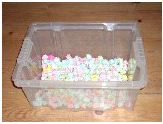
current snapshots of my next action balls basket


close-up of next action balls (blog exclusive)
Currently I’m trying to shift my ‘goal oriented’ communication from email to blogs. It remains to be seen whether this is a feasible approach, but there are a few promises:
- less noise. If you know that your output might persist, you think twice before stating the obvious.
- it creates a corpus of shared history. OK, many do collect or archive or print out their emails, I usually trash them as soon as possible. The never ending stream of asynchronous and atomic messages makes it difficult even between two people to discuss issues, and almost impossible for distributed groups. The format blog also helps people joining a project orienting themselves (what has been going on,…).
- it creates a shared topic and knowledge space. Blogs are searchable, postings can be tagged and grouped, I use Textpattern which also makes it easy to extract persistent pages and thematically related sections.
—
Comments:
also, du hast wenigstens was zu tun. wenn du einen tipp brauchst, wie du bei samorost weiterkommst, frag mich :o) und ich glaube, nach dem klavier ging’s erst richtig los.
posted by dielux : 3/13/2005 11:53:48 PM
A labeler is just the best thing
I just listened to an interview with David Allen hosted by Richard Giles at the Gadget Show. Favorite quote:
..that’s one of the most bizarre tools you can get is a labeler.. there is something mystical happening to your life when you start to label your files..
Entertaining and informative probably also for non GTD adaptees.
Surrogate TV


cyclists in snow
Part II of my escape your TV challenge (part I is here).
For whatever reason watching television requires the synchronicity of all other viewers to be really enjoyable. Whatever is on, you can be sure millions of others are staring at the same bullshit at the same moment. This obviously creates some sense of imagined community, some remote connectivity via the shared info/image/distraction flow. I started to record everything I might or might not want to watch and then usually just forget about it – even The Simpsons. (This effect corresponds with Cory Doctorow’s notion of the Outboard Brain – your VCR/TiVo just can watch TV better than you.)
Next Action Balls 7

current snapshots of my next action balls basket
Originally I wanted to describe my latest and greatest GTD setup here, but then I followed a pointer of Merlin Mann to an article of Mark Wieczorek, who rises the killer question for assigning Next Actions to Contexts:
Can I act on this item as soon as I read it?
This superbly captures the essence of what David Allen is thinking about the @Context lists – and challenges me with some balancing to do between the two forces zen like minimalism and playful hacking upon the system. It’s hard to get rid of habits.
related:
What @actions do you use? – recent thread on Contexts at the GTD forum, CosmoGTD’s posting contains a nice analogy from free jazz, which might be a good idea to consider: you have to learn to play INSIDE first, before you can play OUTSIDE
Notes on the Making Money Session - Bloggercon III
IT Conversations hosts the complete audio archive of the Bloggercon III held November 2004. My sixth stop was the Making Money Session, hosted by Doc Searls.
quick notes:
- making money with blogs vs. making money because of blogs
- with blogs (words / content as product): ads; selling something; donations; stuff writer – some jobs seem to appear; (‘nickle and dime mindset’)
- because of: networking mechanism; solicit your ideas; blogs as relationship tools (with potential partners, customers); as a laboratory; as a reference for what you have been thinking or doing;
- questions framing the topic: do you write for readers? do you deliver content? do you have an audience? is your blog a brand? what do you want to get out from blogging (passionate thinking / a job)?
- tons of use cases for blogs with different implications (journalistic, marketing, entertaining, educational,…) – there is no monolitic approch, but blogs can be leveraged for many things.
- business blogs – not the same old marketing hogwash please, but real people behind the facade (Scoble effect).
- no thrill possibilities for money: provide infrastructure
- brand: borrowed from the cattle industry
- social and cultural capital: if you start writing for a newspaper you inherit the reputation from day one. As blogger you start from below zero and need to build this trust. This is a valuable lesson.
Previous stops were the Newbie Session, the Overload Session, the Journalism Session, the Academia Session, and the Emotional Life Session.
Notes on the Emotional Life Session - Bloggercon III
IT Conversations hosts the complete audio archive of the Bloggercon III held November 2004. My fifth stop was the Emotional Life Session, hosted by Julie Leung.
quick notes:
- what do you put on your blog, what not? (everything; respect privacy of your family and others; not telling things that are not yours;…)
- how can blogs touch emotions, help connecting people? Blogging is a system of telling and listening, of passing on personal experiences, of resonating with each other, of interconnecting people who are out of the spotlight. But: how much are you really connected?
- blogs vs. wikis: blogs are (usually) the voice of one person (might be ego-centric, authoritative, seperating); wikis produce a shared space.
- personal vs. informational blogs (this is my life / check what I know).
- blogging enforces to take an opionion on a regular basis, also allows to change your opinion.
- raising your opinion as employee (could change work culture since common problems are there anyway vs. don’t talk about clients or your employer)
- outdated notion of privacy?
- two conflicting instincts: flee (bite) vs. welcome. Blogging might bridge these.
- building knowledge on group processes
- via blogging also little stories can gain visibility (vs. scripted pseudo reality tv shows)
Previous stops were the Newbie Session, the Overload Session, the Journalism Session, and the Academia Session.