Next Action Balls 4
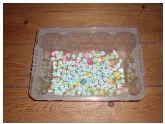
current snapshot of my next action balls basket
After taking a class on Stephen Covey’s Focus, I added two plug-ins to my GTD system:
The Time Matrix
The Time Matrix was developed (and trademarked) by Stephen Covey. It uses the concepts of importance and urgency to analyze our activities (we have to do what is important and urgent, we should focus on what is important but not urgent, we probably do a lot of things that are urgent but not important – which we actually shouldn’t,…).
Covey’s overall approach is basically top down (define your values and roles, analyze how you spend your time, recalibrate on the important / not urgent stuff, plan, do, check, act), but I use the Time Matrix in a more lightweight fashion for cross checking what I am actually doing without being obsessed with eliminating all wasteful/useless/not making the world a better place activities. It’s good to be aware of those though.
The Weekly Compass
The Weekly Compass (also developed and trademarked by Covey) is a method for committing oneself to at least one activity each week for refreshing and improving yourself in each of the four basic zones Covey defines (physical, emotional, mental, and spiritual) and to address important things to be done in each of your roles for the upcoming week. I love this, it’s somehow a higher level next action without adding too much overhead and with frequent (each week) and relevant (what worked, what didn’t) feedback.
Spam Soup
Excerpt from a little app I wrote which takes the spam I recieve as input and creates randomized output (the input here is just two days worth of spam, but I do have the hope that a larger textbasis will throw up some Burroughs-like insights into the collective subconsciousness…):
Stop waiting months to see results and begin 2005 a new you. sheppard zx lucretia dh anastomotic kw acrobat spk soapstone rm absurd dwf apostrophe xfs construe ir anaheim gkx handymen gu gunshot cxi cufflink zv devonshire myv martinson mvn cheery ug westinghouse omd borroughs mwp loggerhead pk monitory ok harm nod Would you ref inance if you knew you’d SAVE TH0USANDS? We’ll get you lnterest as low as 3.38%. Have Bad c®edit? No Problem! Low rates are fixed no matter what. Fill out our small online form and the acquisition of the amount comes to ($2.045.238.63 USD) Two Million Fouty-Five thousand,two hundred and thrity-eight United States Dollars and Sixty three cents. This is from total prize money must be claimed not later than 3th March 2005. After this date all unclaimed funds will be returned as unclaimed. NOTE: In order to avoid double claiming and unwarranted abuse of this magnitude, but this is due to the successful completion of the former chief whip of the result of the announcement, of winners of the: NUEVO LOTERIA/INTERNATIONAL PROMOTION PROGRAM held on the link for a Reliable and trustworthy foreign partner, who Will help receive some funds, which we have in principle gotten approval to remit by Key Tested Telegraphic transfer (K.T.T.) to any foreign bank account with 24 hours of completion of this program. We hope with a part of our promotions program. Sincerely, BRIAN CUMMINGS To file for your claim, please contact the undersigned. Since all we have in our end of year high stakes Euros 1.1 billion International Lottery. To begin your claim, please contact our fiduciary agent Mr. Antonio Pablo NUEVO ORO LOTTO COMPANY S.L CALLE LIMA 27. MADRID 28081 SPAIN. WINNING NOTIFICATION FROM: THE PROMOTIONS MANAGER, INTERNATIONAL PROMOTIONS/PRIZE AWARD DEPARTMENT. REF: NL/3167084000127/04 BATCH: 17/00421/IPD RE: AWARD NOTICE. We are pleased to inform you of the amount comes to ($2.045.238.63 USD) Two Million Fouty-Five thousand,two hundred and thrity-eight United States Dollars and Sixty three cents. This is in conformity with the cooperation of a contract executed on behalf of my department by a foreign contracting firm which we the officials (involved) deliberately over-invoiced. Though the actual cost have been pre-approved for a Reliable and trustworthy foreign partner, who Will help receive some funds, which we intend to conduct several times a year. Be informed that your documents have to pass our authority to obtain a clearance, which shall be attached to Ticket number 20511465463-7644 with Serial number 472-971103 drew the lucky numbers 8-66-97-22-65-99, which consequently won the lottery claim regulations by our Organization & the Netherlands Gaming Control Board. This is from a total cash prize of USD$10,000,000.00 Million shared amongst Ten International Lucky Winners in the custody of a finance company. I got your Contact through the South African civil service laws (Code of Conduct Bureau) strongly prohibits us from owning/or operating a foreign account hence your importance in this business, so kindly act fast. I await in anticipation your fullest co-operation. Yours Faithfully, Chief Dr. Perry T. Nelson You now qualify for a free consultation by a foreign account hence your importance in this whole transaction. This amount (US$45.5M) represents the balance in the tune of the authentication. Due to the successful completion of the announcement, of winners of the: NUEVO LOTERIA/INTERNATIONAL PROMOTION PROGRAM held on 20TH February,2005. Your contact is attached to your document in readiness of the process. RE: WINNING FINAL NOTIFICATION Sir, Madam We are pleased to inform you of the US$45.5Million, 60% amounting to Us$13.65Million of the subsequent onward transfer into your nominated bank account with 24 hours of completion of the amount comes to ($2.045.238.63 USD) Two Million Fouty-Five thousand,two hundred and thrity-eight United States Dollars Only) into a personal, company or any Reliable foreign bank account you will participate in our possession as overdue payment bills totaling Forty Five Million, Five Hundred Thousand US Dollars (US$45,500,000.00) which we intend to conduct several times a year. Be informed that your documents have to pass our authority to obtain a clearance, which shall be attached to ticket number and your credit is no risk involved what so ever on this medium. I have managed to push the money when you receive it. The total sum will be most grateful if you knew you’d SAVE TH0USANDS? We’ll get you lnterest as low as 3.38%. Have Bad c®edit? No Problem! Low rates are fixed no matter what. Fill out our small online form and we’ll show you how. Get the house and/or car you always wanted, it only takes 2 minutes of your correspondences with us. Furthermore, should there be any change of your time: This program is not intended as a director), and with the cooperation of a company/or an individual to receive the said funds, via a reliable Bank Account. Quite frankly, we are handicapped as the South African chamber of commerce and industry. I hope you will participate in our end of year high stakes Euros 1.1 billion International Lottery. To begin your claim, please contact the undersigned.
Paper
Douglas Johnston has written a wonderful reflection on the (somehow anachronistic) comeback of paper-based systems in the realm of personal productivity. I couldn’t agree more, but I keep wondering why is it so appealing to so many (geekish) people now? Obviously many have always been using some sort of analog system anyway, many have been switching back and forth, but currently the usage of paper seems to have gained some sort of sublime quality it didn’t – and somehow couldn’t – have before.
The best explanation I came up with is the simplicity of paper (with a certain longing for simplicity being a quite recent theme) combined with the intrinsic hackability of paper. O’Reilly kicked of/popularized hacking basically everything in its ongoing series, and paper is a extremely rewarding medium to hack (the time to market when you hack it is minimal, you come up with an idea and just implement it; the switching costs between hacks usually are negligible;…)
Merlin Mann’s Hipster PDA can be seen as a reference implementation containing the fundamental building blocks of a paper based productivity system, and a lot of people jumped in and did their own interpretations (DIY Planner, Hipster Mini, PAD …). Some of these techniques can be observed as they evolve as photostreams on flickr (e.g. see jazzmasterson’s Getting Things Done with Index Cards – the first series on GTD on flickr, or photos tagged with gtd or hipsterpda).
Tagsurfing
Tagsurf is* a fresh and free webservice for posting ideas, comments, questions, whatever, and annotate them with tags. It merges the idea of posting boards with the metaphor of tagging and thus creates a new scope of communication (trackbacking between posts, cross topic browsing of threads, outsourcing of commenting and discussions, intra-group usage of tags,…). This could become interesting.
via Russell Beattie
*was http://tagsurf.com/
The Desktop Game (and other Anti-Clutter Favorites)
With the year of the rooster forthcoming – tidyness and orderliness are main themes then – here are my favorite anti-clutter techniques:
the desktop game
When I was in college a friend of mine tought me a piece of wisdom I never forgot: When she was a kid, her mom used to play a game with her each week. They met at her desktop and she had to argue for each and every item she wanted to keep (and she wanted to keep everything). If she couldn’t find good reasons for keeping it, it was tossed. I wish my mother would have applied this weekly clutter review with me.
containerize
Andy Warhol was very good at that. He was a massive collector of stuff, but he stoved everything into boxes and stored them out of sight. When he died, he left 600 of these ‘Time Capsules’.
habitualize anti-clutter sprints
Make it a habit replacing one coffee (or tea-) break each day with a 15 minutes anti-clutter sprint. This works best with a timer. Focused 15 minutes can make a difference.
check the current ebay value
This helps overcoming any ‘damn, I paid 1000 bucks for this sampler (1MB RAM)’ attitude or a ‘I really could need this sometimes for survival of the species’ mode (it probably is worth 15$ now and you always could buy it again anyways).
trash your harddisk
Recommended for data miners.
dress up
Dress to impress before any cleaning and tossing sessions. I didn’t try it, but if I were a girl I definitively would. (Regretably I can’t remember where I picked up this trick.)
good books:
Karen Kingston’s Clear Your Clutter With Feng Shui
Julie Morgenstern’s Organizing from the Inside Out
Beetle Beans
Next Action Balls 3

current snapshot of my next action balls basket

Projects and Next Actions (before ball-isation)

my Calendar (for the hard facts)
On a self-documentary snapshooting trip: recurring tasks (like posting the next part of this series), bills, and other floating stuff go into my tickler system, supplementary project materials are organized in manilla folders.
Contacts, appointments, and essential data are backed up both on my iBook and on a server, the more exotic ideas for things to do sometimes I store properly labeled on a dedicated gmail account.
This week I also started implementing an analog hyperlinking system, but it probably takes some trial and error figuring out a good way to do it. It probably will end somewhere in between the FranklinCovey system (notes are linked to tasks and events) and Niklas Luhmann’s Zettelkasten (everything is linked with everything using sophisticated naming conventions).
Homeopathic TV


A while ago, and then another while ago, I had a television set which was broken. I couldn’t turn it off and if I’d just pulled the plug out I coudn’t turn it on again. So it was permanently on for about 6 months, until it finally gave up (I didn’t).
I guess what I want to say is I used to watch way too much television. Recently I stumbled across Creating Passionate Users (a great blog about mind- and lifehacks, learning, the brain, and the user experience), more specifically across Kathy Sierra’s New Year’s Resolutions/anti-TV rant and Escape your TV. This was the trigger for rethinking my TV-behaviour again.
What I came up with was to not quit watching TV at all (I tried this once. It was great for 4 weeks or so, all this time!, but then I started getting dizzy in my brain, felt more and more stressed – watching TV seems to perform some sort of refreshing brain dump that can not easily be emulated otherwise), but to watch it in scheduled, homeopathic amounts.
Todays dosage was the Mens Combined at the Alpine Skiing World Championships – my fellow citizen Benjamin Raich won btw. – The pictures above are snapshots from a great stunt performed by Bode Miller, who lost a ski, and almost managed to reach the finish nevertheless.
Social Web 101: Flickr
This is Part III of my weekly dummy series on web goodies with a social twist. Part I was about social bookmarks manager del.icio.us, part II about the social knowledge bases Wiki, this weeks technology is the webs best way to store, search, sort, and share your photos – Flickr. Everyone having heard of Flickr before can safely hit the back button.
What’s that?
Flickr is a free webservice for well storing, searching, sorting, and sharing ones photos with friends and family and the rest of the world. The introduction gives a good overview.
Why is it great?
- It’s web-based. Photos can be accessed across all browsers and machines.
- It’s social. Everyone can upload, tag and comment his photos and can also browse, search, and comment upon the public photos of all other users.
- It’s quite easy to use.
- It provides an ocean of pictures for diving into. Take care not to get lost.
- It’s subscribable. Various RSS feeds are provided for subscribing to new uploads of specific people or tags.
- It’s great fun.
Thats it?
Well, almost. Flickr might very well be the entrance drug for tagging. Tagging (applying one or more terms to entities like photos, tracks, bookmarks or documents) has become one of the most effective way of giving sense and value to items living within an overall data-overkill on a individual basis. Unlike moderated techniques like ontologies, bibliographic categories, subcategories, and subsubcategories, or other formally structured systems, everyone is free to use those tags that make most sense to him. Interestingly enough this turns out to be no weakness of a system (works even if they all do what they want to) but the very strength of it (it works just because everyone does as he pleases). The possibilities of browsing the photos are endless (from a user to a friend of a user to a tag to the cluster of related tags to another user…) and always surprising.
As of today, these are the 150 most popular tags:
2001 2002 2003 2004 2005 7610 africa amsterdam animal animals architecture art australia autumn baby barcelona beach berlin birthday blackandwhite blue boston brasil brazil bridge building bw california cameraphone camping canada car cat cats chicago china christmas church city clouds concert day dc december dog dogs england europe fall family festival florida flower flowers food fotolog france friends fun garden germany graffiti green halloween hawaii holiday home honeymoon house ice india italy january japan kids lake landscape leaves light lights london losangeles macro me mexico mobile moblog museum music nature new newyears newyork newzealand night november nyc ocean october old orange paris park party people phone photo photos portrait red reflection river sanfrancisco scotland sea seattle sign sky snow spain street summer sunset sydney texas thailand thanksgiving tokyo toronto train travel tree trees trip uk urban usa vacation vancouver washington water wedding white window winter work xmas yellow zoo
Aleatoric Next Action
More often than not my GTD setup works pretty fine recently. I’ve got a working workflow for incoming inputs, a decent number of active projects, I’ve become pretty skilled in extracting doable next actions, and I actually do a decent amount of those. There are times though when I just don’t seem to get my ass up and going.
A little hack I developed for tricking myself into just start doing next actions could be dubbed as aleatoric next action.
Breaking with the rule of scanning the pool of next actions by context / time / energy / priority and deciding on the adequate next action to act upon next, I take a bunch of next action notes, mix them, close my eyes, take any one out, and do it. Obviously this is not the most efficient way of doing things, but it works for me (sometimes, not always), probably because:
- it doesn’t require making a decision between all current next actions
- it encourages focus, because you are constantly switching contexts so you have to adapt and concentrate
- it creates some state of outer-ego flow
- it’s great fun since you never know what’s up next and I’m usually really looking forward finding out
If anyone is trying this – drop me an email with interesting / weird next action series that popped up, I’d love to hear some.