Salmon is the new orange

I’m in Italy for three weeks soon, so my theme is getting a little vacation too.
Hipster PDA Hacks
Vendors of old fashioned digital PDAs probably are scratching their heads due to a dramatic decrease of sales after 3/11/2004 (the day Merlin Mann introduced the Hipster PDA). You know the story of the analog paradigm shift thereafter (and vendors of index cards give themselves high fives, probably without knowing why).
I’m currently consolidating my bookmarks, and Hipster PDA hacks made quite a long and impressive list (which is far from being exhaustive, and if you’ve been hanging around at 43 Folders or scanning del.icio.us, Flickr, or Technorati, you probably know them all):

The Hipster Mini works just like the regular Hipster PDA, but instead of using index cards, it uses blank business cards (best kept in elegant cases)
The Hipster Tablet PC takes a different approach: bigger and cheaper,
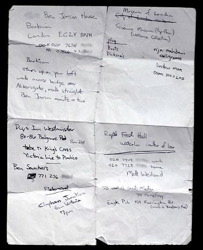
and so does Jason Kottke,

but undisputed champion in this category is Clark Venable’s Palmster PDA

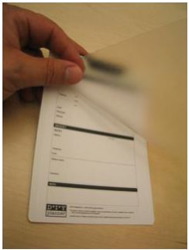
Christian Eriksson’s Zipster and Fliptop Hipster PDA reuses ZIP cases and DuraClip® Clear Front Vinyl Report Covers
The Guest Check PDA takes a soft approach.
Obvious Diversion upgrade the Hipster PDA with a Clock.
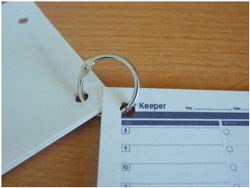
Leo Faoro punches holes and binds the cards with loose-leaf rings,
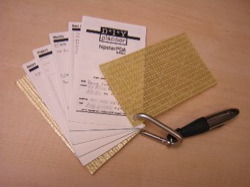
Doug Giuliana binds the cards and protects them with pieces of sailcloth,
and J Wynia gives a step by step tutorial for piercing and punching HPDAs here. He also created a full fledged index cards based grocery process.

Tammy Cravit developed a Portable Workspace based on post-its,

and David Meadows’ Duckster PDA is a DIY reinterpretation for teachers.
Javier Cabrera has many more Hipster PDA models and various pimps.

Merlin even spotted an ancestor as used by Thomas Jefferson: Ye Olde Hipster
Good readings:
Organizing Your Hipster PDA – Merlin’s authorative follow up
The Hipster PDA and various Hipster PDA Hacks at the 43F Wiki
Interesting implementation of GTD using Moleskines – Moleskines and index cards avant la lettre at the GTD forum
The Personal Analog Device at the c2 Wiki takes a geek peek
Paper? Ain’t that extinct? from Douglas Johnston (who also is the dad of the most lovely D*I*Y Planner, but templates for the Hipster PDA would fill another list)
Even Wired and the Washington Post were impressed.
Tag, and on, and on...
Just stumbled upon Kevan Davis’ The Surrealist, a site full of advanced text juggling experiments.
What’s Your Spammer Name? – (mine is Scops J. Lockian)
The Advertising Slogan Generator – (got the title for this entry there)
The Infinite Teen Slang Dictionary
banana
n. LSD without school.
“All your banana are belong to us, Shana.”
and highly recommended The Prior-Art-O-Matic
Design #2537609117
It’s a chainsaw that runs on methane and looks bigger than it really is.
And The Generator Blog is dedicated to “software that creates software to play around and have fun with.” – more than 400 generators are (currently) listed.
Word Clouds
For fans of tag clouds who need a higher level of granularity: Analys.icio.us.
This tool takes a string or an URL and generates a beautiful map of the used words (stop words can be removed):

Double Bind
btw, if you are like me tearing out your hair in despair, because you can’t assign an owner to this damn fish, you might enjoy switching positions and become a psychiatrist for abused cuddly toys:

(this is Lilo, showing symptoms of double bind)
Whose fish is it anyway?

There are five houses in a row in different colors. In each house lives a person with a different nationality. The five owners drink a different drink, smoke a different brand of cigar and keep a different pet, one of which is a Walleye Pike.
There are 15 hints given (some of them really suspend reality – the Dane drinks tea??), and only estimated 121,348,731 people will be able to solve the puzzle.
Office Supply Sculpture
Jason Fried from 37signals proposed a productivity tip yesterday: Throw everything on your desk in a box (and just take out what you really really need, and throw out the remaining items in the box after 30 days).
But how would eliminating all unused clutter affect the boredom even the most challenging job yields every once in a while? Without useless stuff or toys to play with we would be devastated!
So my tip is to keep everything (well seperated and containerized!). Once boredom strikes you can stimulate your creativity or spike your energy level by creating small works of art reusing the things you would have tossed otherwise.


Free encryption for your Hipster PDA
One of the shortcomings of the Hipster PDA is the vulnerability of your data, if you lose your Hipster (or parts thereof). Even if your handwriting is terrible, people still might be able to decipher your next actioned groceries or business ideas.

Handywrite is a beautiful (and open sourced) handwriting system which will give you pretty good protection of your data from spying eyes. You only write what you hear using the simplest possible strokes. Handywrite even offers data compression, if you apply the built-in abbreviating principles.
Central Tag Agency
If an entry starts with
There are taggers and then there are tag voyeurs.
it must be good. William Blaze has written two excellent ramblings about tagging (Tagging – an introduction into tagging from a user perspective – and Tagging/Meta Voyeurism – an outline of an info-economical critique of tagging) that are well worth reading.
Tagsploitation
To paraphrase Jon Udell: Tag-enabled applications open the door to new opportunities for bookmark management. del.icio.us is still the blueprint of all social and taggable bookmarking systems, but in the spirit of mimesis and alterity a decent number of alternatives have emerged.
(Inspired by Douglas Johnston’s Beginner’s Mind and Robert Daeley’s Zen Pockets I’m currently trying to clean up my del.icio.us bookmarks, but fail miserably in letting go of some applications…)
Here is a rundown of some other social bookmarking applications, I’ll just highlight the differences to del.icio.us, the list of features is not exhaustive.

BlogMarks – “enlarge your bookmarks”
- BlogMarks has thumbnailed preview of URLs
- you can mark bookmarks as private
- tags are clouded by default; if you browse a tag, a subcloud of related tags appears
- you can sort by popularity
- you can search within the titles and descriptions of all users (not only your own)

Furl [furl.net]
- see A del.icio.us furl Workflow. Regarding tags Furl takes a hybrid approach: both topics (categories) and keywords (tags) are used.

Jots [jots.com]
- it also caches the resources making them accessible even if the original has gone
- it’s written in Ruby (which usually is an indicator that it’s a work of love…)
- it has got a view called Link Leaders (who was the first to bookmark a popular URL)
- and a built-in post to blog feature
- and a jotted? bookmarklet (has an URL been jotted by other members?)
- you also can create groups for restricting bookmarks to distinguished persons only
- and browse your archive by date added

Yahoo’s My Web 2.0 [myweb2.search.yahoo.com]
- see my previous posting

Netvouz – “your bookmarks online”
- you can mark bookmarks as private
- it has got hotpicks (prefered spots for links you visit often)
- and link validation
- popular links are computed as aggregated hotpicks

Shadows – “tag comment rate search”
- Shadows has the look and feel of a forum (users can add comments to bookmarks and rate them)
- uses UberTags. “UberTags go where no tag has gone before” – basically by combining freshness and popularity

Simpy [simpy.com]
- besides bookmarks you can add (and tag) notes
- you can mark bookmarks as private
- Simpy indexes the pages you bookmark so you can also search within the content (I’m not sure, if Simpy is also storing a cached copy)
- you get boolean search!! for an arbitrary combination of search fields – see the documentation (this makes Simpy my undisclosed favorite)
- you can add a search field for your simpyfied links to your blog
- you can access your bookmarks programmatically via a REST api.

Spurl [spurl.net]
- Spurl is a lot like Furl. You can not create a local backup of your archive, though.
- has groovy publishing features (for adding categories to your blog,..)

- a collaborative bookmarking / rating / discovery system
- you can define interests, StumbleUpon will find a community with interests similiar to yours
- you can rate links (thumbs up or down)
Happy Tagging!